
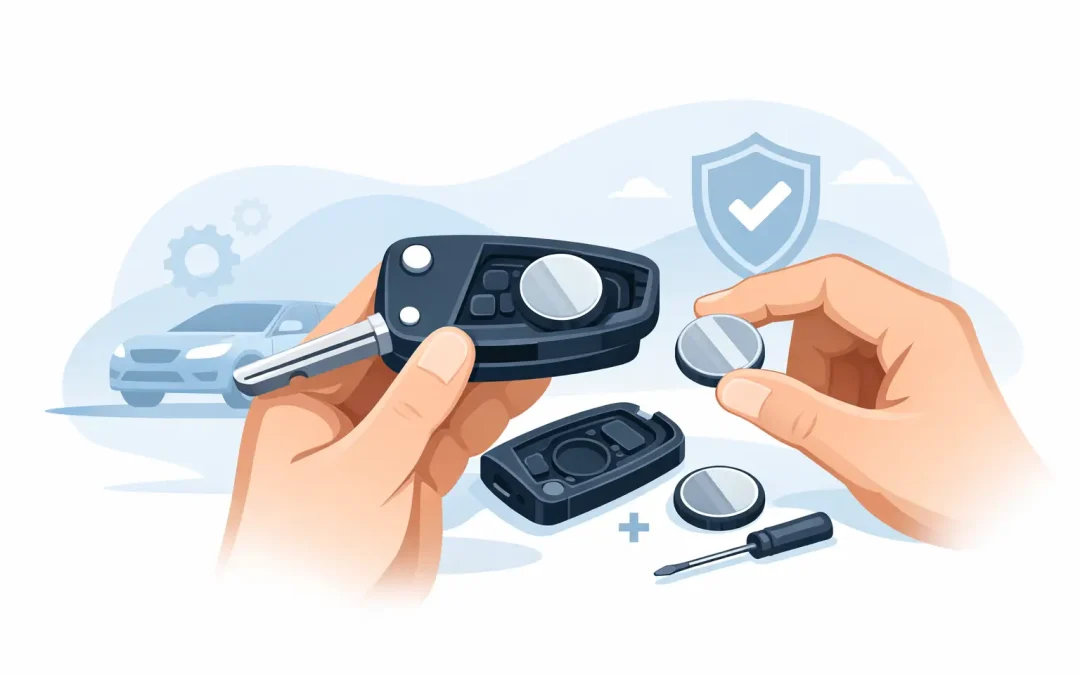
Your key fob usually waits until the worst possible moment to act up – outside work, in the rain, or when you’re already late. If you’re searching for how to car key battery replacement, the good news is that many fobs are straightforward to sort out at home, as long as you open them carefully and use the correct battery.
A flat battery does not always mean the whole key is failing. In many cases, the remote simply loses range, becomes intermittent, or stops locking and unlocking the car unless you’re standing right next to it. Replacing the battery is often a quick fix. The part that causes trouble is not the battery itself, but using the wrong type, forcing the case open, or damaging the small clips and circuit board inside.
When a car key battery really needs replacing
Most drivers notice the problem in stages. The buttons may need a firmer press, the car may react slowly, or the remote might work one minute and not the next. Some vehicles also show a dashboard warning for key battery low. If your car still starts with push-button ignition, but the remote functions are unreliable, that is another common sign.
It is worth remembering that symptoms can overlap. A damaged key shell, worn buttons, water inside the remote, or internal circuit faults can look like a dead battery. If your key has been dropped, crushed, or exposed to moisture, a new battery may not solve it on its own.
How to car key battery replacement without damaging the fob
Before you start, work on a clear table with good lighting. Small parts are easy to lose, and some keys have tiny clips that can spring free if the case opens suddenly.
First, identify whether your key has a removable mechanical key. Many modern fobs have a release button that slides the emergency key out. Once that key is removed, you will usually see a notch where the two halves of the fob separate. Use a small flat tool carefully and twist gently rather than prying aggressively. If the casing does not move with light pressure, stop and check for a hidden screw or a second release point.
Once open, look at the battery before touching anything. Note the battery code, usually something like CR2032 or CR2025, and pay attention to which side faces up. Taking a quick photo with your phone helps avoid guesswork later. Then remove the old battery carefully, using a plastic tool or a fingernail if possible. Metal tools can slip and damage the contacts.
Fit the new battery in the exact same orientation. Make sure it sits flat and fully under the retaining clips. If the battery is slightly raised or forced in, the fob may not work even though the battery is new. After that, align the case properly and press it back together evenly until it clicks shut.
Choosing the right battery matters more than most people think
The battery number is not interchangeable just because it looks similar. A CR2032 and a CR2025, for example, are close in size but not identical in thickness. Some fobs tolerate a substitute, while others do not. If the wrong battery is fitted, the case may not close properly or the electrical contact may be poor.
Quality also matters. Cheap batteries sometimes arrive with low charge or inconsistent output. For a key you rely on every day, it is worth using a fresh, branded battery from a reputable source. Check the packaging date if possible, and avoid loose batteries that have been rolling around in a drawer for years.
Try not to touch the flat faces of the new battery more than necessary. Oils and dirt from your fingers can affect contact over time. Hold it by the edges and keep the inside of the fob clean while it is open.
Common mistakes during car key battery replacement
The most common error is forcing the case apart in the wrong place. That can snap the tabs that hold the shell together, leaving the key loose or unable to close properly afterward. The second is fitting the battery upside down. It sounds obvious, but it happens often, especially with fobs that use tight battery trays.
Another mistake is assuming every problem is battery-related. If the buttons feel soft, the shell is cracked, or the key has stopped working completely after being dropped, the battery may only be part of the issue. Some remotes also lose synchronization after a battery change, although many recover as soon as the new battery is installed.
You should also be careful with older or worn keys. On a fragile fob, a simple battery replacement can expose damage that was already there, such as failing solder joints or broken button pads. That does not mean the battery change caused the fault, but it can make the underlying problem more obvious.
What to do if the key still does not work
If you’ve replaced the battery and the remote still does nothing, start with the basics. Check that the battery is the correct type, installed the right way around, and making proper contact. Open the fob again and look for bent clips, dirt on the contacts, or pieces that are out of place.
If the battery is correct and the key still fails, the issue may be deeper inside the remote. Internal components can crack from impact. Water can corrode the board. Buttons can wear through. In some cases, the key needs to be tested, repaired, or replaced rather than opened again and again.
It also depends on the vehicle. Some keys are simple battery-powered remotes, while others are part of a more complex transponder or proximity system. The battery usually powers the remote functions, but the immobilizer chip may be separate. That is why a car may still start even when the lock and unlock buttons stop responding.
When to replace the battery yourself and when to call a specialist
If the fob is in good condition and opens cleanly, a home battery change is often perfectly reasonable. It is a simple job when the shell is intact and the only symptom is weak or inconsistent remote operation.
If the key is expensive, damaged, water-affected, or part of a smart key system that already behaves unpredictably, caution makes sense. The cost of a battery is small. The cost of a broken remote, damaged shell, or a key that now needs full replacement is not.
This is especially true if you only have one working key. If that key is already failing, it is better not to take risks. A specialist can confirm whether the problem is just the battery or whether the remote, chip, or casing needs attention. That can save time and prevent you from ending up with no usable key at all.
A few smart habits that help you avoid key problems
Replacing the battery is only one part of keeping a car key reliable. If your remote is your only key, having a spare made before it fails is usually the most practical move. It is almost always easier and less expensive to copy a working key than to deal with a total loss situation.
It also helps to keep the key dry, avoid dropping it, and change the battery as soon as you notice the range getting weaker. Waiting until it stops completely can turn a minor maintenance job into an inconvenient day.
For drivers who rely on their vehicle for work, school runs, or daily travel, a key is not something you want to leave to chance. A quick battery replacement may be all you need. If not, getting the key checked early is the safest way to stay mobile and avoid a bigger problem later.

Recent Comments