
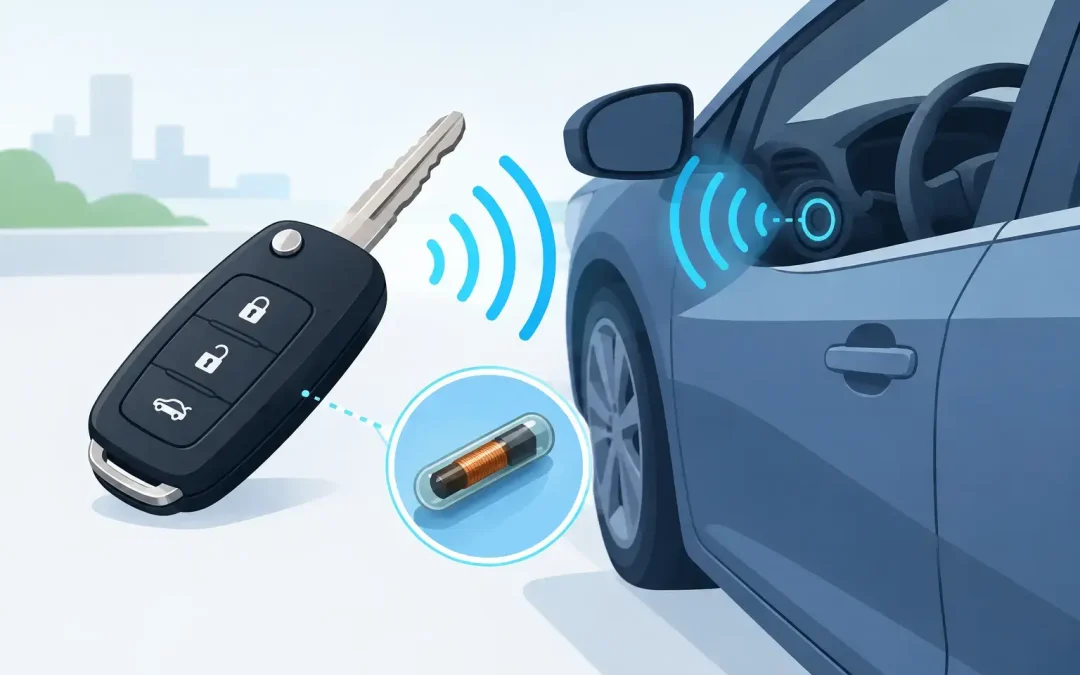
A replacement key can look perfect, turn in the ignition, and still leave you with a car that will not start. That is the practical reason to understand how transponder chip keys work. On many vehicles, the metal blade opens the door and turns the lock, but the small electronic chip inside the key must also prove it belongs to that vehicle.
This extra security is designed to make hot-wiring and unauthorized key copying much harder. It is useful protection, but it also means a lost, damaged, or poorly programmed key needs more than a quick cut at a hardware store. The key must be cut correctly and electronically matched to the vehicle.
What Is a Transponder Chip Key?
A transponder key contains a tiny radio-frequency identification chip, usually housed in the plastic head of the key or inside a smart-key fob. The word “transponder” comes from “transmitter” and “responder.” The chip responds when the vehicle asks it for identification.
These keys became common from the late 1990s onward, although the exact systems vary by manufacturer and model year. Some have a traditional metal blade with a plastic head. Others use a remote fob with an emergency key blade. Push-button-start vehicles may use proximity fobs instead of a key you insert into an ignition.
The common purpose is the same: the vehicle’s immobilizer system checks for an approved electronic credential before allowing the engine to start.
How Transponder Chip Keys Work Step by Step
When you place the key in the ignition and turn it, or bring a compatible fob into the vehicle, an antenna around the ignition barrel or inside the cabin sends out a low-power radio signal. This energizes the chip in many traditional transponder keys.
Most basic transponder chips do not need a battery. They draw a small amount of power from that signal, then send their stored identification code back to the vehicle. The immobilizer control unit compares that code with the authorized codes stored in its memory.
If the code matches, the vehicle permits starting. Depending on the vehicle, it may enable the fuel system, starter circuit, engine control module, or several systems at once. If the code does not match, the engine may crank but not start, start briefly and shut off, or not crank at all.
This exchange happens in seconds. From the driver’s seat, it feels as simple as turning a key. Behind the scenes, the vehicle is making a security decision every time.
Fixed Codes and Rolling Security Codes
Older transponder systems commonly use a fixed identification code. The vehicle stores the code, recognizes it, and allows the engine to start. A replacement key for this type of system still needs the right chip and must normally be programmed into the vehicle.
Newer systems can use encrypted or rolling-code technology. Instead of accepting one simple, permanent code, the vehicle and key use a changing or encrypted challenge-response process. This improves security, but it also makes programming more specialized. The correct diagnostic equipment, software access, and technical knowledge matter.
That is why an inexpensive online key blank is not always a bargain. Even if the shell and blade appear identical, the chip may be the wrong type, the remote frequency may be incompatible, or the key may not be capable of programming to your specific vehicle.
The Key Blade, Chip, and Remote Are Different Parts
Drivers often call every vehicle key a “remote,” but several functions can be separate. Knowing the difference helps explain what has gone wrong and what needs replacing.
The metal blade is mechanical. It operates door locks and, on conventional ignitions, turns the ignition cylinder. The transponder chip is the anti-theft component that allows the engine to start. The remote buttons handle convenience functions such as locking, unlocking, opening a trunk, or operating a panic alarm.
A fault in one part does not automatically mean the others have failed. For example, a dead remote battery may stop the lock and unlock buttons from working, while the transponder chip still starts the car. On the other hand, a key may unlock the door and turn the ignition normally but fail to start the engine because its chip is damaged, missing, or not programmed.
On some modern fobs, a weak internal battery can affect proximity entry and push-button starting. Many models still have an emergency backup starting method, such as holding the fob against a marked area or placing it in a designated slot. Your owner’s manual can identify the correct procedure for your vehicle.
Why a Newly Cut Key May Not Start the Car
Key cutting and transponder programming are two separate jobs. Cutting makes the blade fit the locks. Programming teaches the vehicle to recognize the chip or fob.
A replacement may fail to start the vehicle for several reasons. The blade may have been cut inaccurately, the key may contain the wrong transponder chip, the chip may not have been programmed, or the vehicle may have an immobilizer fault. Water damage, a cracked key head, and a key that has been dropped repeatedly can also damage the chip or its internal connections.
There is another issue with used keys. On many makes, a previously programmed chip cannot simply be erased and reused on another vehicle. Some remotes can be prepared for reuse, while others are permanently locked to the original car. It depends on the manufacturer and system, so it is worth confirming compatibility before spending money on a secondhand key.
What Programming a Transponder Key Involves
Programming is the process of adding an approved key or fob to the vehicle’s immobilizer system. On a small number of older vehicles, an owner may be able to follow a manual sequence using working keys. For most modern cars and vans, professional diagnostic equipment is required.
A trained automotive locksmith connects approved programming equipment to the vehicle, identifies the system, and follows the correct security procedure. This may involve reading security data, accessing immobilizer information, programming a new chip, and checking that the engine starts and the remote functions operate correctly.
The process varies widely. Some vehicles can be programmed quickly with all existing keys present. Others require a security PIN, an online authorization process, removal of a module, or specialized procedures when every key has been lost. European vans and higher-security systems can be especially complex.
For that reason, a locksmith should ask for the vehicle make, model, year, and whether any working key remains. A photo of the existing key or fob can also help identify the correct replacement before the appointment.
Lost All Keys? The Vehicle Can Still Be Recovered
Losing the last key is stressful, particularly when you rely on a van for work or need your car for family travel. It does not automatically mean the vehicle has to be towed to a dealership.
A properly equipped mobile automotive locksmith can often cut and program a new key on-site. The exact method depends on the vehicle, but the work may include gaining entry without damage, decoding the lock, cutting a new blade, and programming a compatible transponder key or remote.
Proof of ownership and identification are normally required. That protects the vehicle owner and ensures keys are only made for authorized customers. If the lost key creates a security concern, it may also be possible to erase the missing key from the vehicle’s memory so it can no longer start the engine.
When to Get a Spare Transponder Key
The best time to arrange a spare key is when you still have one that works. It is usually faster, less disruptive, and less expensive than replacing every key after the last one is lost.
A spare is particularly useful for households sharing a vehicle, drivers with long commutes, and tradespeople whose van is essential to their income. Keep it somewhere secure away from the vehicle, not hidden inside it. A spare that is locked in the glove box is not much help during a lockout.
If your key shell is cracked, the buttons only work intermittently, or the key needs to be wiggled before the car recognizes it, deal with it before it fails completely. A small key problem has a habit of becoming an urgent one at the least convenient time.
Choosing the Right Help for a Chip Key Problem
Transponder work is not just about owning a key-cutting machine. It requires the correct key stock, up-to-date programming equipment, vehicle-specific knowledge, and care around the vehicle’s electronics. An incorrect procedure can leave you with a key that does not work or, in some cases, a vehicle that needs further recovery work.
A qualified mobile auto locksmith can assess whether the issue is the key, remote battery, ignition lock, immobilizer, or another fault. They should explain what is needed before work begins and test the replacement fully before leaving.
If you have one working key today, having a tested spare made is a straightforward way to avoid a much bigger interruption tomorrow.

Recent Comments