
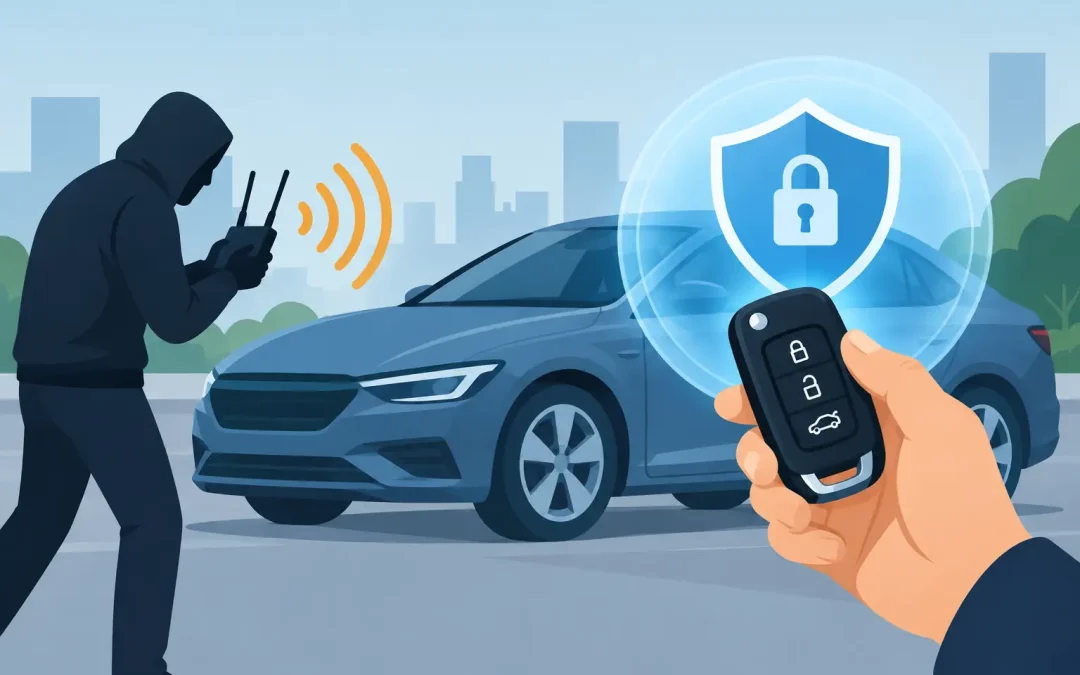
A keyless fob makes getting into your car or van quick. It can also create an opportunity for thieves using relay equipment to extend the signal from a key inside your home to a vehicle outside. Knowing how to protect keyless entry does not mean making your vehicle inconvenient to use. It means making a few sensible changes that make your vehicle a less attractive target.
Relay theft is often quick, quiet, and does not require a broken window or forced lock. That is why prevention starts with where you keep your keys, how you use the vehicle, and how quickly you deal with a missing or faulty fob.
What keyless entry relay theft looks like
Many keyless entry systems constantly listen for a nearby vehicle. When the vehicle detects the fob, it allows the doors to open and, on some models, permits the engine to start. Relay theft takes advantage of that convenience.
Typically, one offender stands near the vehicle with a relay device while another stands close to the property holding a second device. The equipment passes the fob’s signal between them, making the vehicle believe the genuine key is nearby. The thieves may then open the doors, start the engine, and drive away.
This does not mean every keyless vehicle will be targeted, and not every theft involving a keyless car is a relay attack. Older vehicles, stolen keys, weak door locks, and keys left in plain sight can all be factors. Still, keyless owners should take relay theft seriously, particularly if their car or work van is parked on a driveway or close to the front of the property.
How to protect keyless entry at home
The simplest step is to keep keyless fobs in a signal-blocking pouch or metal key box when they are not being used. A properly made Faraday pouch prevents the fob from communicating with the vehicle. Put every keyless fob in it, including the spare. Protecting the everyday key while leaving the spare on a hallway table defeats the point.
Test the pouch before relying on it. Stand beside the vehicle with the fob inside, then try the door handle or start button. If the vehicle responds, the pouch is not blocking the signal properly, may not be fully closed, or may be worn out. Replace it rather than assuming it is still doing its job.
Where you store keys matters as well. Avoid leaving them beside a front door, window, letterbox, or ground-floor wall. Moving them farther into the home gives thieves less chance of picking up the signal. It also reduces the risk of someone reaching or fishing keys through an insecure letterbox.
A metal tin can sometimes reduce a signal, but it is not a guaranteed solution. Different containers and different fobs behave differently. A purpose-made signal-blocking pouch is inexpensive, easy to test, and more dependable for daily use.
Check whether your fob has a sleep mode
Some modern keyless fobs have a motion sensor or sleep mode. When the fob has not moved for a period of time, it stops transmitting until it is picked up again. This can reduce relay theft risk when the key is sitting still at home.
The feature is useful, but it should not be treated as a reason to stop using signal-blocking storage. Not every model has it, settings vary by manufacturer, and drivers do not always know whether the function is active. Check the vehicle handbook or ask a qualified vehicle key specialist if you are unsure.
Make the vehicle harder to take
Signal protection addresses one method of theft. Physical security adds a second obstacle, which is particularly worthwhile for vehicles parked overnight or vans carrying tools.
A visible steering wheel lock can be an effective deterrent. It takes time and noise to defeat, and thieves generally prefer the easiest vehicle available. For a van, consider a pedal lock, gear lever lock, or other quality physical device suited to the model. The right choice depends on the vehicle and how it is used, but a visible layer of security is rarely wasted.
If you own a van, do not overlook the cargo area. Factory locks may protect access to the cab but offer limited protection against attacks on side and rear doors. High-security van locks can make a major difference, especially for tradespeople who carry valuable tools. Keep tools out of sight where possible, and remove high-value items overnight if that is practical.
Parking also plays a role. A well-lit, overlooked spot is generally preferable to an isolated area. At home, parking closer to the property may make a relay attack easier if keys are near the front wall, so use a signal-blocking pouch and consider the layout rather than relying on distance alone. At work or in public, choose locations with foot traffic, lighting, and visible cameras where possible.
Do not ignore a lost key or damaged remote
A lost keyless fob is more than an inconvenience. If it can be linked to your vehicle, whoever finds or steals it may have access to it. Act promptly. A vehicle key specialist can erase the missing key from the vehicle’s memory and program replacement keys, so the old fob will no longer start the vehicle.
The same applies if a remote has been stolen from a bag, jacket, or work site. Waiting to see whether it turns up can leave the vehicle exposed. The cost of reprogramming is often far less than the cost and disruption of a stolen vehicle.
A damaged fob deserves attention too. Cracked cases, weak buttons, water damage, and intermittent operation can leave you stranded at the worst time. More importantly, a driver may start using an insecure routine, such as hiding a backup key in or around the vehicle. Never leave a spare key in the glove box, under a seat, inside a wheel arch, or taped beneath the vehicle. Thieves know those hiding places.
Keep a working spare key, but keep it secure
Having a spare is one of the most practical ways to avoid an emergency. It can save a callout when the main key is lost, broken, or locked inside. For a business vehicle, it can prevent a missed job or a lost day of work.
The spare needs the same protection as the main key. Store it securely away from the vehicle, ideally in a signal-blocking pouch if it is keyless. Do not hand it to an unverified buyer, leave it with someone who no longer needs access, or keep it in a vehicle used by multiple employees without a clear key-control routine.
For fleets and trades businesses, record who has each key and collect keys immediately when an employee leaves. It may feel formal for a small operation, but it prevents uncertainty if a vehicle goes missing or a key cannot be accounted for.
Be cautious with aftermarket keys and programming
Replacement key costs can make a cheap online fob look tempting. Some aftermarket keys are suitable when supplied and programmed correctly, but quality varies. A poor-quality remote may fail quickly, have limited functions, or create programming problems.
More importantly, vehicle key programming should be carried out by someone who can confirm ownership and use the correct equipment for the vehicle. A properly programmed replacement, paired with removal of lost keys from the vehicle memory, is a security measure as well as a convenience.
A mobile vehicle key specialist can often cut and program keys while you wait at home or work, avoiding a dealer visit and helping you get back on the road without unnecessary delay. If the lock, ignition, or remote is damaged, ask for the underlying fault to be checked rather than simply replacing the visible part.
Quick questions drivers ask
Does turning off keyless entry stop relay theft?
On vehicles that allow it, disabling passive entry can reduce relay theft risk because the doors will not respond simply because the fob signal is nearby. You may need to press a button on the fob to unlock the vehicle instead. It is a good option for some owners, but the steps differ by make and model, and it can be less convenient if you regularly load children, equipment, or tools.
Will locking the car twice help?
Double-locking can improve protection against some methods of entry on certain vehicles, but it does not reliably prevent a relay attack if the vehicle accepts the relayed fob signal. Use it where appropriate, but combine it with signal-blocking storage and physical security.
Can thieves copy a key just by standing nearby?
Relay theft is not the same as permanently copying your fob. The equipment extends the live signal while the genuine key is available. That is why blocking the signal at home is so useful. If a key is lost or stolen, have it removed from the vehicle’s memory rather than assuming it cannot be used.
A keyless vehicle should make your day easier, not leave you worrying every time it is parked outside. Put the fob away in a tested signal-blocking pouch tonight, keep a secure spare, and deal with missing or faulty keys before they become a bigger problem.

Recent Comments