
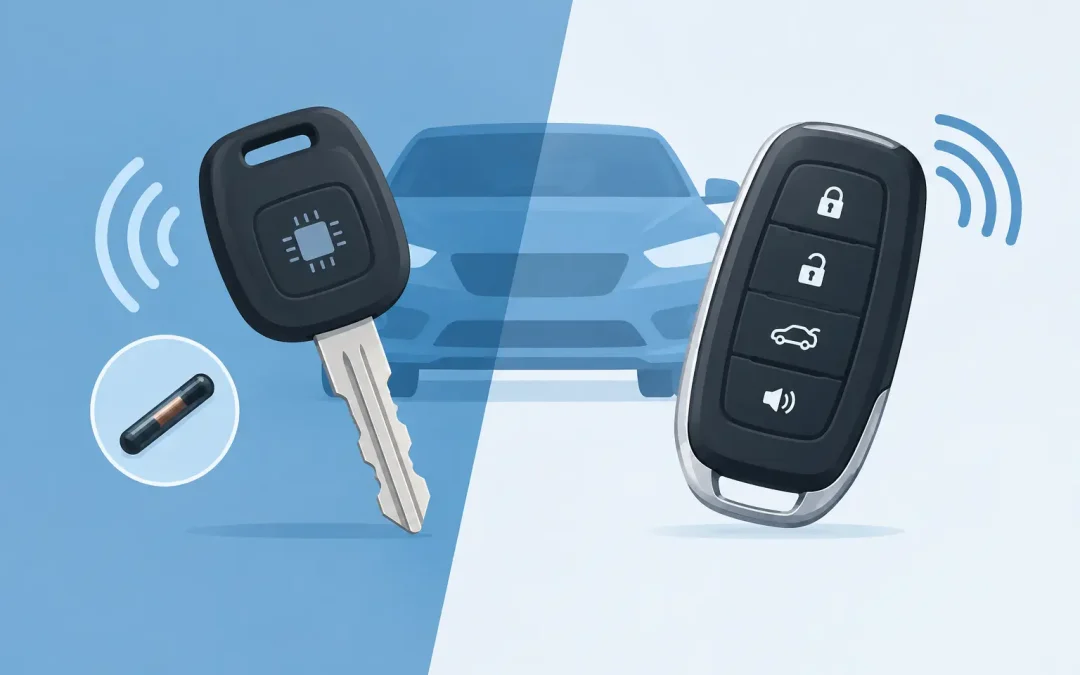
Your car may still unlock when the remote battery is weak, yet refuse to start without the correct programmed chip. That is where the difference between a transponder key versus smart key matters. Both are designed to prevent theft, but they work differently, fail differently, and can require different replacement methods.
If you have lost a key, damaged a fob, or want a spare before the only working key disappears, knowing which system your vehicle uses helps you get the right help without delay. A vehicle key specialist can identify the setup from the vehicle details and supply, cut, and program the correct replacement at your location.
What Is a Transponder Key?
A transponder key looks much like a traditional vehicle key. It may have a fixed plastic head, a folding blade, or buttons for central locking, but its most important part is a small electronic chip inside the key head.
When you turn the key in the ignition, the vehicle reads that chip. If the code matches the vehicle’s immobilizer system, the engine is allowed to start. If it does not match, the car may crank but not start, or it may start briefly and then shut off.
The metal blade and the chip have separate jobs. The blade operates the door and ignition lock, while the transponder chip proves to the vehicle that the key is authorized. This is why a newly cut key can turn in the ignition but still fail to start the car until it is programmed.
Common transponder key problems
A transponder key can stop working after water damage, a hard impact, a cracked key head, or a failed chip. Sometimes the key itself is fine and the fault lies in the ignition antenna ring, immobilizer, or vehicle battery. Diagnosis matters because replacing a key will not cure every no-start fault.
If your remote buttons have stopped working but the car still starts, the transponder is usually still being recognized. In that case, the remote section may need a battery, repair, replacement case, or reprogramming rather than a complete new key.
What Is a Smart Key?
A smart key is a keyless fob that communicates with the vehicle while it is nearby. Instead of inserting a metal key into the ignition, you normally keep the fob in your pocket or bag, press the brake or clutch as required, and use a start button.
Many smart key systems also allow keyless entry. Touching a door handle or pressing a small button on it tells the vehicle to look for the authorized fob. If it recognizes the fob, the doors unlock. When you walk away, some vehicles can lock automatically or warn you that the fob has been left inside.
Most smart keys include a hidden emergency blade. This blade is there for situations such as a flat vehicle battery or a dead fob battery, when the keyless entry system cannot operate normally. The exact location of the blade and emergency starting procedure varies by vehicle, so it is worth checking before you need it.
A smart key is not just a remote
It is easy to call every button-operated car key a smart key, but that is not accurate. A conventional remote key may lock and unlock the doors from a distance while still requiring you to put the key in the ignition. That is generally a remote transponder key, not a true smart key.
A smart key usually works through proximity detection and push-button starting. It may still contain a transponder function as part of its security system, which is why the terms can overlap. The practical difference is how you access and start the vehicle.
Transponder Key Versus Smart Key: The Main Differences
The biggest difference is the driver’s experience. With a transponder key, you insert and turn a key. With a smart key, the vehicle detects the fob nearby and starts with a button press.
The replacement process also differs. A transponder key usually needs a correctly cut blade and programming for the immobilizer. A smart key may need programming for immobilizer authorization, remote locking, keyless entry, and push-button starting functions. Some vehicles also require all existing keys to be present during programming, while others do not.
Smart keys are generally more complex and can cost more to replace because there is more technology inside the fob. That does not mean every replacement requires a dealership. A properly equipped automotive locksmith can often cut emergency blades, program compatible keys, and test the system while you wait.
There are trade-offs beyond cost. A transponder key is simpler, usually tougher, and less dependent on a working fob battery for starting. A smart key is convenient, especially when your hands are full or you use your vehicle throughout the day, but it gives you more electronic components that can be damaged or go flat.
How to Tell Which Key Your Vehicle Uses
Start with the ignition. If you insert a key blade and turn it to start the engine, you most likely have a transponder key or remote transponder key. If your vehicle has a start button and starts when the fob is inside the cabin, you have a smart key system.
Do not rely only on the shape of the key. Some vehicles use a folding blade with remote buttons but still have a standard ignition. Others have a smart fob with a concealed mechanical blade that you may never have used.
Your vehicle’s year, make, model, and VIN can help a specialist confirm the correct key type. Photos of your existing key are useful too, but they are not always enough because similar-looking keys can use different chips, frequencies, or programming methods.
What Happens When You Lose Each Type of Key?
Losing the only transponder key does not always mean the vehicle needs to be taken to a dealer. A mobile locksmith can often gain entry without damage, cut a new blade, and program a replacement key on-site. The vehicle may need security access or diagnostic equipment, particularly on newer models.
With a lost smart key, the replacement may involve more programming steps, but the same principle applies. The new fob must be recognized by the vehicle before it can start the engine or operate keyless functions. For security, it is often sensible to remove the missing fob from the vehicle’s memory so it can no longer be used to start the car.
The process depends on the vehicle. Some makes and models have dealer-only procedures, restricted key data, or security systems that take additional time. A professional should explain what is possible before work begins, rather than promising a one-size-fits-all solution.
When a Spare Key Makes the Most Sense
The best time to arrange a spare is when you still have one working key. A duplicate can usually be made faster and with fewer complications because the original provides a working pattern and programming reference.
For a transponder key, a spare protects you from a simple loss, broken blade, or damaged key head. For a smart key, it also protects you from the disruption of a lost fob, a damaged circuit board, or a fob that has gone through the wash.
This matters even more for work vans. A missing key can stop a day of appointments, leave tools inaccessible, and create pressure to make a rushed decision. Keeping a tested spare in a safe place is a practical safeguard, not an unnecessary extra.
Do Not Assume a Dead Battery Means a Bad Key
Smart key fob batteries eventually run down. Warning signs can include reduced remote range, inconsistent keyless entry, dashboard messages, or the need to hold the fob close to the start button. Replacing the battery promptly can prevent an inconvenient lockout.
A dead fob battery does not normally erase the key’s programming. Many smart vehicles have an emergency reader position that lets you start the car by holding the fob against or near the start button. Check your owner’s manual for the correct procedure, as guessing can waste time when you need to get moving.
If a fresh battery does not solve the issue, the fob may have internal damage or the vehicle may have a separate fault. A specialist can test the key and identify whether repair, replacement, or further vehicle diagnosis is needed.
Whether you use a basic transponder key or a proximity smart fob, treat your only working key as a weak point. Arrange a tested spare while the vehicle is accessible and the solution is straightforward.

Recent Comments