
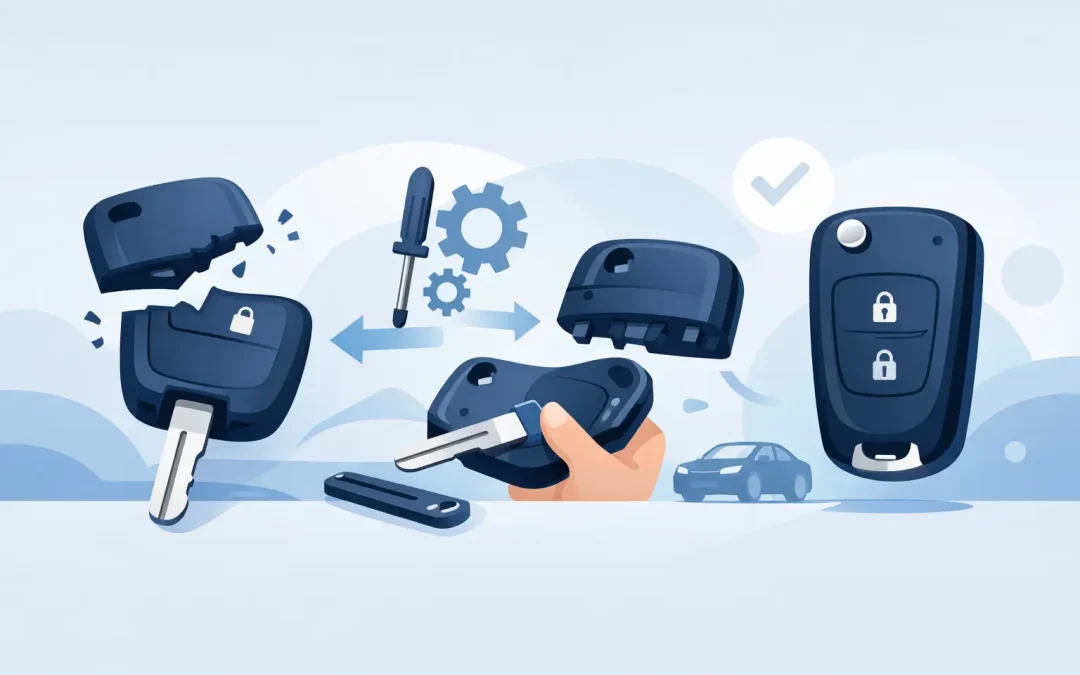
A broken car key shell replacement can often turn a cracked, loose, or badly worn remote back into a key you can use every day. If the buttons have fallen out, the blade no longer folds properly, or the plastic case has split around the key ring, you may not need a complete replacement key. The right repair depends on whether the electronics inside the remote are still working.
For drivers, the difference matters. A new shell is usually quicker and less expensive than replacing and programming a whole remote. But forcing damaged parts into a poor-quality case can leave you with a key that fails when you need it most. A vehicle key specialist can assess the remote, protect the working components, and tell you honestly whether a shell swap is the sensible fix.
What a car key shell replacement actually fixes
The shell is the outer plastic housing of your remote key or flip key. It holds the buttons, battery cover, key blade mechanism, and the internal circuit board in place. It is the part most likely to crack after years of being dropped, sat on, or carried with heavy keys.
A replacement shell is a good option when the remote still locks and unlocks the vehicle, but the casing is damaged. Common signs include a broken key ring loop, missing button pads, a split seam, a loose battery cover, or a flip blade that will not stay closed.
The working circuit board and transponder chip are moved from the old shell into the new one. Because those original electronic parts are retained, programming is often not required. The vehicle still recognizes the same remote and immobilizer chip.
That said, not every damaged key is just a shell problem. If the remote has stopped responding, the battery terminals are damaged, the circuit board has corrosion, or the transponder chip is missing, a new case alone will not restore it.
Shell replacement or a complete new key?
The quickest way to decide is to look at what still works. If the buttons operate the central locking and the engine starts normally, the electronics are likely healthy. In that situation, replacing the broken outer case is often the practical choice.
A complete replacement key is more likely to be needed if your vehicle will not start with the key, the remote has suffered water damage, or the board is cracked. A lost transponder chip is another common issue. On many keys, this is a small separate chip inside the shell. Without it, the blade may turn the ignition but the immobilizer can prevent the engine from starting.
There is also a middle ground. Sometimes the remote buttons have failed but the immobilizer chip still works. In that case, a specialist may be able to provide and program a replacement remote while transferring or replacing the transponder as required. The best option depends on the make, model, year, and key design.
Why the wrong shell can cause trouble
Replacement shells are not all made to the same standard. Two cases may look almost identical online, yet have different button positions, blade mounts, battery locations, or internal clips. A shell that does not fit precisely can press the buttons continuously, allow the circuit board to move, or make the key blade unreliable.
Flip keys need particular care. The blade is held under spring tension, and dismantling it without the correct method can send small parts flying or damage the new casing. The blade must also be the correct profile and secured properly. A key that feels loose in the shell can break again, jam in the ignition, or fail in a door lock.
Some modern keys have a separate emergency blade, while others use a blade fixed directly into the remote. Smart keys and proximity fobs can be even more delicate because their internal antennas and battery contacts need to sit in exactly the right place. This is why a visual match is not always enough.
When you should not delay a damaged key repair
It is easy to keep using a cracked remote while it still works. The risk is that the case can finally separate when you are away from home, leaving the circuit board, chip, or blade lost on a driveway, parking lot, or job site.
A damaged key should be dealt with promptly if the battery falls out, the blade wobbles, the button pad is torn, or the case no longer holds together. Van drivers and tradespeople should take this especially seriously. A failed key can mean lost time, missed appointments, and a vehicle full of tools that cannot be secured properly.
It also makes sense to arrange a spare while your existing key is still present and working. Creating a spare from a working key is generally simpler than starting from a lost-key situation. If the damaged remote fails completely, you still have a way to get home and avoid an urgent replacement call.
How a professional broken car key shell replacement works
A proper repair is more than snapping electronics into a new plastic case. The key is inspected first to establish whether the remote functions, whether the immobilizer chip is present, and whether the blade can be reused safely.
The usual process involves four careful checks:
- Testing the remote buttons and vehicle starting function before work begins.
- Matching the replacement shell to the exact key style and blade arrangement.
- Transferring the circuit board, transponder chip, battery, and blade without damaging them.
- Testing the remote, blade operation, and engine start once the key is reassembled.
If a fresh blade is needed, it can be cut to match the vehicle. If the key needs programming, that can be handled as part of the wider replacement service rather than leaving you with a case that looks new but does not work.
For customers in Oldbury and the West Midlands, Remote Key Man can carry out many key repairs and replacements from a fully equipped mobile workshop. That means there is no need to risk driving with a failing key or arrange a dealership visit simply to deal with a damaged remote.
Can you replace a key shell yourself?
Some straightforward fixed-blade remotes can be transferred at home, especially where the circuit board lifts out easily and there is no separate chip to lose. It can save money if you have the exact shell, the right small tools, and confidence working with delicate components.
The trade-off is the risk. A transponder chip can be tiny and easy to miss. On certain keys it may be glued into a corner of the shell, rather than attached to the circuit board. Throw away the old casing before checking for it and the vehicle may no longer start. A slipped screwdriver can also damage button contacts or break the board.
DIY work is less suitable for flip keys, smart keys, water-damaged remotes, and any key that already has an intermittent starting or locking fault. If the key is your only one, professional help is usually the safer choice. There is no backup if a home repair goes wrong.
Protecting your replacement shell
Once the key is repaired, keep it away from heavy bundles of keys that put strain on the ignition and key ring loop. Use a simple protective cover if the remote is regularly carried in a work bag, pocket with tools, or exposed to rain. Avoid pressing buttons through a tight pocket, as constant pressure can wear the rubber pad and drain the battery.
If your remote starts working only at close range, replace the battery before assuming the shell is at fault. If a fresh battery does not help, have the key checked before it stops working altogether. Small issues are generally easier to solve while the vehicle can still be started.
A cracked remote does not have to become a lost-key emergency. Getting the shell assessed while the electronics are still intact can keep your vehicle secure, your workday moving, and your only key safely in one piece.

Recent Comments