
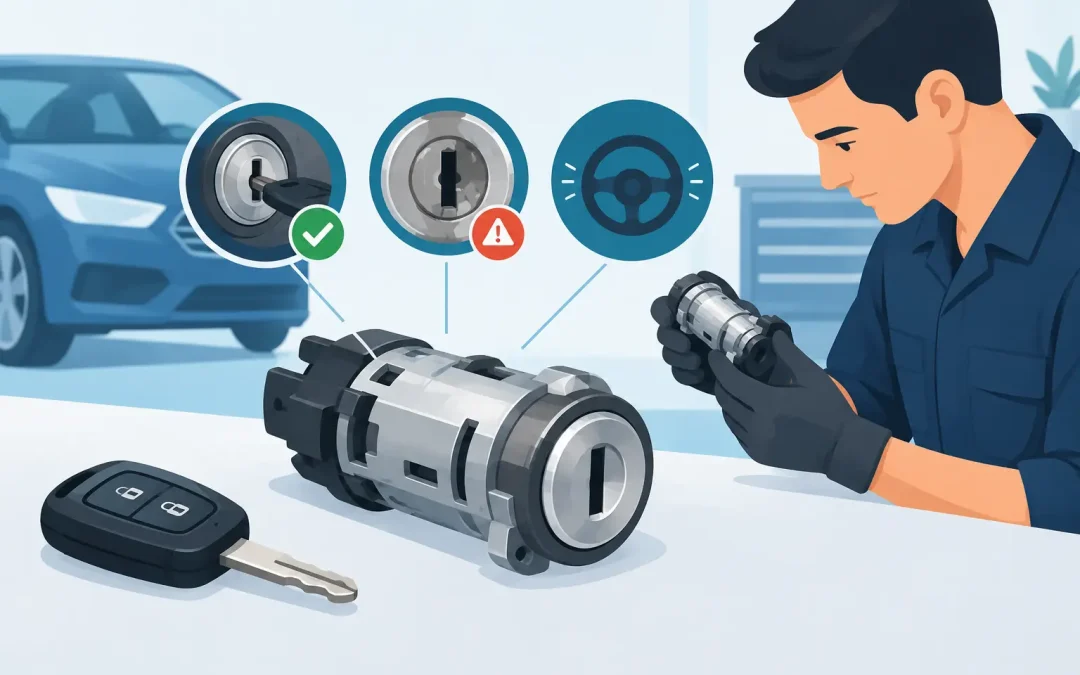
A key that suddenly will not turn can stop your whole day before the engine has even started. Knowing how to check ignition barrel problems can help you tell the difference between a simple steering-lock bind, a worn key, and an ignition cylinder that needs professional attention.
The ignition barrel is the mechanical cylinder your key enters. On many newer vehicles, it works alongside an immobilizer chip, transponder antenna, electronic steering lock, or push-button start system. That means a no-start fault is not always an ignition barrel fault, even when the problem appears as soon as you turn the key.
Start with the symptoms, not the screwdriver
Do not begin by removing trims or forcing the key. A key that is jammed, bent, or twisted can break in the barrel, turning a manageable repair into a more involved extraction and replacement job.
First, notice exactly what the vehicle is doing. Does the key slide into the barrel normally? Does it turn part way but stop before the ignition comes on? Does it turn fully but the dashboard stays dead? Or does it turn and the engine crank but fail to start? Each symptom points to a different possible cause.
If the key will not enter fully, the issue may be dirt or debris in the keyway, damage to the key blade, or internal wear in the barrel. If it enters but will not turn, worn internal pins, a steering-lock bind, or a worn key are more likely. If it turns normally but the engine does not start, the problem may be with the key’s transponder, battery, vehicle immobilizer, or electrical ignition switch rather than the barrel itself.
How to check ignition barrel movement
Park safely, apply the parking brake, and make sure the vehicle is in Park or neutral. Use only normal hand pressure. An ignition key should not need force.
Insert the key and gently try to turn it while moving the steering wheel slightly left and right. On many vehicles, pressure against the steering lock can hold the key in place. Keep light turning pressure on the key while easing the wheel in the direction where it has a little movement. Do not jerk the wheel or twist the key hard.
If the key turns after the steering wheel is relieved, the barrel may be working correctly. The steering lock had simply loaded up after the wheels were left against a curb or turned when the vehicle was parked.
If it still will not turn, remove the key and inspect it in good light. Look for obvious bends, cracks, worn grooves, damaged teeth, or a blade that looks rounded compared with a spare. A heavily worn key may no longer lift the barrel’s internal pins into the correct positions. This is common on older cars and working vans that see constant use.
Try a genuine spare key if you have one. This is one of the most useful checks because it separates a key problem from a barrel problem quickly. If the spare turns smoothly and the everyday key does not, stop using the worn key. A replacement key cut accurately from the correct information can prevent it from sticking or snapping later.
Do not test with a copied key alone
A poorly copied key can reproduce the wear of the original and create the same fault. If both keys are old copies, neither gives a clear answer. A locksmith can assess the key profile and cut a new key to the vehicle’s proper specification where possible.
Check whether the fault is mechanical or electrical
A barrel has a mechanical job: accepting and turning the key. The electrical ignition switch behind it sends power to the vehicle systems. These components can fail separately.
If the key turns from lock to accessory and ignition positions with its usual feel, but no warning lights appear, the barrel itself may not be the issue. Check simple causes first, such as a flat vehicle battery, loose battery terminals, or a blown main fuse. If the lights come on but the starter does nothing, the vehicle may have a starter, clutch-switch, brake-switch, park-neutral, immobilizer, or electrical switch fault.
A transponder issue often looks different. The key turns, the dash powers up, and the engine may crank, but it will not start or it starts briefly and stops. You may also see a security or key warning light. The metal blade can be perfectly good while the chip inside the key is damaged, missing, or no longer recognized by the vehicle.
This distinction matters. Replacing an ignition barrel will not fix an unprogrammed replacement key or an immobilizer communication fault. Likewise, programming a new remote will not repair a barrel whose internal components are worn or seized.
Signs the ignition barrel is likely failing
Ignition barrels usually show warning signs before they fail completely. Pay attention if the key regularly needs wiggling before it turns, feels rough at one point in its travel, sticks when you try to remove it, or only works when inserted a certain way.
Other warning signs include a key that rotates too freely, a barrel that turns without bringing on the ignition, or a key that can be removed while the engine is running. These are not faults to put off, especially if you rely on your vehicle for work. A failing barrel can leave you unable to start, unable to switch off, or locked out of the steering position at the wrong time.
For vans, the cost of waiting can be more than the repair itself. A missed job, tools left inaccessible, or a vehicle stranded away from home can disrupt an entire workday. Acting when the first symptoms appear is usually the safer option.
What not to do when a key sticks
Avoid spraying household oil, grease, or penetrating fluid into the barrel. These products can attract grit, coat delicate internal parts, and make the problem worse over time. Do not hammer the key, use pliers to twist it, or try to force the barrel with a screwdriver. Those methods can damage the keyway, steering column, or ignition components.
Be cautious with aerosol lock lubricants too. A product may be suitable for some locks but still be the wrong answer when the real issue is a worn key or failed barrel. If you use anything at all, use only a product specifically intended for vehicle lock cylinders and follow the manufacturer’s directions. It should never be used to overcome a key that is clearly binding.
Do not disconnect wiring or remove steering-column covers unless you know the vehicle’s restraint and security systems. Airbag components and immobilizer equipment can be located around the steering column. A professional diagnosis is generally faster than guessing and avoids accidental damage.
When to call an automotive locksmith
Call for specialist help if the key will not turn after the steering-lock check, the key is stuck, the barrel feels loose or inconsistent, or you only have one worn key left. Also arrange help if the key turns but the vehicle displays an immobilizer warning or will not recognize the key.
A mobile automotive locksmith can assess the key, barrel, and vehicle security system at the vehicle. Depending on the fault, the solution may be a correctly cut spare key, transponder programming, non-destructive key extraction, ignition barrel repair, or replacement of the damaged ignition lock. The right repair depends on the vehicle and on whether the fault is mechanical, electronic, or both.
For drivers in Oldbury and the West Midlands, Remote Key Man can handle vehicle key and ignition lock issues at home, at work, or where the vehicle has been left. That saves the need to arrange a tow just to find out whether the problem is the key, the barrel, or the immobilizer.
If your key is still working but it has begun to stick, do not wait for the morning it refuses to turn. Have a spare made and get the barrel checked while you can still move the vehicle on your terms.

Recent Comments