
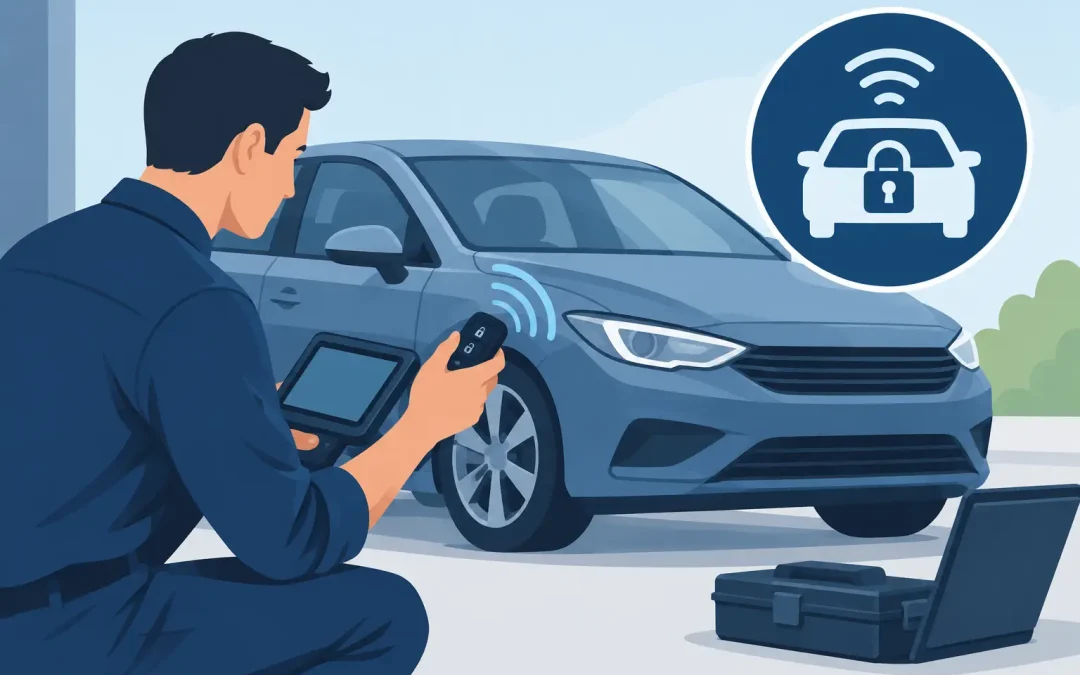
A car that unlocks normally but refuses to start can turn a routine trip into a stressful delay. If you are wondering how to test car immobiliser faults, start with the key and dashboard behavior rather than trying to bypass any security system. The goal is to identify whether the issue is likely to be the key, the vehicle battery, the immobilizer reader, or another starting fault.
Modern immobilizers are designed to stop the engine from running unless the vehicle recognizes an authorized transponder chip or smart key. That protection is useful, but it also means a weak battery, damaged key, or programming problem can leave you stranded even when the physical key still turns in the ignition.
What an immobilizer fault usually looks like
An immobilizer problem does not always mean the engine will not crank. On many vehicles, the starter may turn the engine over, but the engine will not fire or will start briefly and then stop. Other vehicles prevent cranking altogether.
Watch the security or key warning light when you switch the ignition on. Its symbol varies by manufacturer, but it is often a car with a key, a padlock, or a flashing security light. Normally, it should illuminate briefly during the system check and then go out once the key has been recognized. If it continues flashing, stays on, or a message such as “key not detected” appears, the immobilizer system may not be authorizing the start.
That said, a warning light alone is not a final diagnosis. Low vehicle voltage, a flat key-fob battery, a faulty ignition switch, a starter issue, or an engine management fault can create similar symptoms. Testing methodically saves time and avoids replacing the wrong part.
How to test car immobiliser symptoms step by step
Start with the simplest checks. They are safe to do at home or at work and often reveal whether you need a replacement key or a deeper vehicle diagnosis.
Try a known working spare key
If you have a spare key, test it before doing anything else. Use it to unlock the vehicle and attempt to start the engine. If the spare starts the vehicle normally, the problem is likely with your everyday key rather than the car’s immobilizer control unit.
A key can look undamaged while its internal transponder chip has failed, become loose after a drop, or suffered water damage. On older remote keys, the transponder chip may be separate from the remote circuit board. Replacing the remote battery may restore the buttons, but it will not repair or program a failed transponder chip.
If neither key works, do not assume both keys have suddenly failed. Check the vehicle battery and look for other electrical symptoms first.
Check the vehicle battery condition
Immobilizer systems rely on stable vehicle voltage. A weak car battery can cause warning lights, communication errors, and a no-start condition that appears to be key-related. Look for dim interior lights, slow cranking, clicking from the engine bay, or a dashboard that resets when you try to start.
If you have a multimeter, a healthy resting 12-volt battery will generally read around 12.4 to 12.7 volts. A reading near or below 12.2 volts suggests the battery needs charging and should be tested. Voltage can drop further under starting load, so a battery that appears acceptable at rest may still be weak.
Charge or test the vehicle battery correctly before arranging immobilizer programming. If the engine starts normally after the battery is restored, the key may not have been the issue at all.
Check the remote or smart-key battery
For push-button-start vehicles, a weak smart-key battery can prevent reliable detection. Replace it with the correct type and make sure it is installed in the right direction. If your vehicle has an emergency starting position, usually described in the owner’s manual, place the key there and try again.
Many vehicles can still start with a depleted fob battery when the key is held against a marked area or close to the start button. This varies by make and model, so do not force the key into any opening or dismantle trim in an attempt to find the reader.
For a traditional ignition key, the remote battery normally controls locking and unlocking, not the transponder used by the immobilizer. A non-working remote does not automatically mean the key cannot start the vehicle.
Look closely at the key and ignition area
Inspect the key casing for cracks, missing pieces, water damage, or evidence it has been glued back together. A key that has been through a washing machine, crushed in a door, or dropped repeatedly deserves suspicion. Avoid taping a loose chip near the ignition or transferring parts between keys. Improvised repairs can make professional testing and replacement more difficult.
If the key will not turn smoothly, the fault may be a worn or damaged ignition lock rather than the immobilizer. Do not force it. A forced key can snap in the lock and turn a manageable repair into a lockout.
Record the warning-light behavior
Before calling for help, note exactly what happens. Does the security light flash before you start, stay on after the key is turned, or only appear after the engine stalls? Does the engine crank, start for one or two seconds, or do nothing at all?
These details help separate an immobilizer authorization failure from fuel, starter, or engine faults. They also help a mobile automotive locksmith arrive prepared with the correct diagnostic equipment, key blank, and programming approach.
Use diagnostic scanning carefully
A professional scan tool can read fault codes from the immobilizer, body control module, engine control unit, and keyless-entry system. Codes may point to key recognition, antenna ring, steering-lock, communication, or module voltage issues.
A basic code reader that only accesses engine codes may not see immobilizer faults. Even when it does show a code, clearing it does not repair the cause. If the fault returns immediately, there is still a recognition, wiring, voltage, or module problem to investigate.
Avoid buying software or following online instructions intended to disable the immobilizer. Besides creating a security risk, unauthorized programming can corrupt modules, erase working keys, and create a more expensive no-start situation. The proper repair is to restore normal key recognition, not remove the protection.
When the fault is likely to be the key
A key fault is more likely when a tested spare starts the vehicle, the security light responds differently with each key, or the problem began after the key was damaged or exposed to water. It is also common after a customer has had a copy cut without having the transponder properly programmed.
The solution may be a new transponder key, remote key, or smart key programmed to the vehicle. Depending on the make, model, and year, a specialist may be able to add a new key while you wait. In some cases, all existing keys must be present, while lost-key situations may require old keys to be removed from the vehicle’s memory for security.
When it may be more than an immobilizer issue
If both programmed keys fail and the vehicle battery is healthy, the fault may be in the antenna ring around the ignition, keyless-entry receiver, wiring, ignition switch, steering-column lock, or a control module. Water ingress and previous electrical repairs can also cause communication faults.
A vehicle that cranks strongly with no security warning but will not start may have an engine, fuel, spark, or sensor problem instead. A locksmith can confirm key recognition and programming, but an auto electrician or repair shop may be needed where the fault lies elsewhere in the vehicle.
Do not keep repeatedly cranking the engine if the battery is already weak. You may create a second problem and lose useful diagnostic clues.
Get the right help without damaging the vehicle
A trained automotive locksmith can test the key transponder, read relevant vehicle systems, check whether the vehicle recognizes the key, and program a correctly matched replacement where appropriate. This is usually more useful than guessing based on a dashboard light or ordering an unprogrammed key online.
If you only have one working key, arranging a spare before it is lost or damaged is a sensible precaution. It is normally quicker, less disruptive, and less costly than dealing with a no-start situation when you are already late for work or unable to use your van.
A careful test starts with the spare key, battery condition, and warning-light behavior. Once those checks point to a recognition problem, the safest next step is professional diagnosis that protects both your vehicle’s security and your day.

Recent Comments