
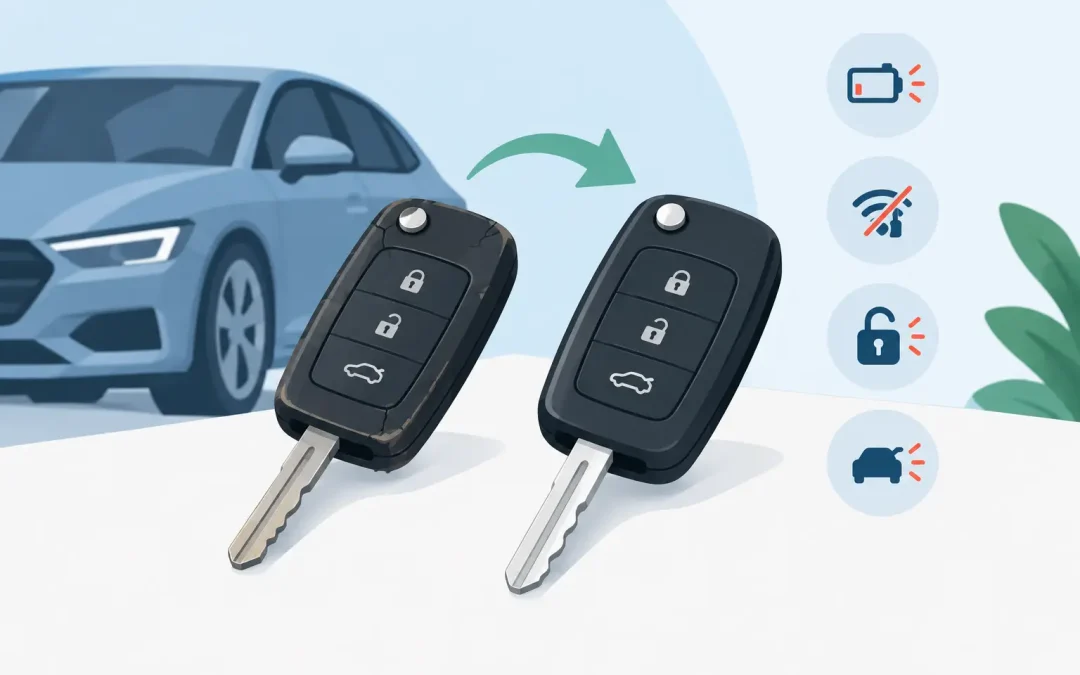
Your remote key works dozens of times a week without much thought – until it does not unlock the car outside work, starts working only at close range, or leaves you stranded with a key that will not start the engine. Remote keys are convenient, but they combine electronics, a battery, an immobilizer chip, and a physical blade in one small item. Any one of those parts can cause trouble.
For drivers and van owners, a failing key is more than an inconvenience. It can mean missed appointments, delayed deliveries, and the worry of being locked out far from home. Knowing the early warning signs gives you the chance to arrange a replacement or spare key before a small fault turns into a lost-key emergency.
What Remote Keys Actually Do
A remote key normally has two separate jobs. The buttons communicate with the vehicle’s central locking system, allowing you to lock, unlock, and sometimes open the trunk or operate other functions. Inside the key is also usually a transponder chip. When the key is placed in the ignition or brought inside a keyless vehicle, that chip communicates with the immobilizer.
This is why a vehicle may unlock but refuse to start, or start normally even though the remote buttons have stopped working. The locking function and the starting authorization are related to the same key, but they are not always the same fault.
Modern smart keys and proximity fobs add another layer. They must be correctly recognized by the vehicle before push-button start will operate. Replacing one is not simply a matter of buying a similar-looking fob. It has to be cut where necessary and programmed to the vehicle correctly.
Signs Your Remote Key Is Failing
The most common early symptom is reduced range. If you need to stand right next to the vehicle before the buttons respond, start with the battery. A weak battery is often a simple fix, but it is worth acting promptly rather than waiting for total failure.
Intermittent operation is another warning sign. Perhaps the unlock button works after several presses, the lock button works but the trunk button does not, or the remote works only on certain days. This can point to worn button contacts, moisture inside the case, damage to the circuit board, or a battery connection that has become loose.
Physical damage matters too. Keys are dropped, sat on, left in damp coat pockets, and carried alongside heavy tools. A cracked case may look cosmetic, but it can expose the electronics to moisture or allow the blade and battery to move. If the blade is loose, bent, or no longer turns smoothly in the ignition or door lock, do not force it. A damaged blade can break and create a larger lock repair job.
The clearest sign of a transponder or programming issue is when the vehicle will not start. You may see an immobilizer or security warning light, the engine may crank but not fire, or a push-button vehicle may display a key-not-detected message. A flat remote battery can affect keyless entry, but it does not automatically explain every no-start problem. Proper diagnosis prevents money being spent on the wrong solution.
Battery Change, Repair, or Replacement?
A new battery makes sense when the key is otherwise undamaged and has simply lost range. Use the correct battery type and fit it carefully. Some key cases are easy to open; others can be damaged if pried apart with the wrong tool. If the remote still does not work after a battery change, there may be an internal fault rather than a battery problem.
Repair can be worthwhile if the original key has worn buttons, a split case, or a damaged blade while the internal electronics remain healthy. Rehousing a key into a new case can protect the circuit board and restore the buttons. However, repair is not always the most reliable choice after water damage, a badly cracked board, or repeated intermittent faults.
Replacement is usually the sensible route when a key is lost, the transponder has failed, the board is beyond repair, or you only have one working key left. It is also a good time to add a spare. A planned spare key is generally simpler and less disruptive than creating a new key after every working key has gone missing.
Why Programming Is Essential for Remote Keys
A replacement remote key must match more than the shape of the original. The frequency, chip type, remote board, blade profile, and vehicle security system all need to be compatible. Even a fob that looks identical may not work with your specific vehicle.
Programming tells the vehicle to accept the new remote and transponder. Depending on the make, model, and year, this may involve specialist diagnostic equipment, security codes, or access to the vehicle’s onboard systems. The process also needs to confirm that the remote buttons work and that the vehicle starts correctly before the job is complete.
This is where online replacement fobs can become a false economy. Some are poor-quality copies, some contain the wrong chip, and some cannot be programmed to the advertised vehicle. A cheap remote that cannot lock, unlock, or start the car is not a saving. The right part, correctly cut and programmed, is what restores dependable access.
Lost All Your Keys? Do Not Force the Locks
Losing the last key can feel like an immediate dealership job, but it does not always require towing the vehicle away. A properly equipped mobile automotive locksmith can often attend the vehicle, gain entry without damage, cut a new key, and program it on site.
Avoid trying to force the door, smash a window, or use improvised tools. Modern vehicle doors contain wiring, airbags, weather seals, and lock components that are expensive to damage. Non-destructive entry is designed to get you back inside while protecting the vehicle.
If your vehicle is a work van, speed matters even more. Tools, stock, appointments, and your ability to earn may all be behind a locked door. Specialized vehicle locksmith equipment can make a major difference, particularly with higher-security van locks and more complex keys. Remote Key Man provides mobile key cutting, remote programming, spare keys, and non-destructive vehicle entry for drivers who need a practical solution where the vehicle is parked.
The Value of Having a Spare Key
A spare key is not just for households with two drivers. It is a backup for a broken key, a misplaced key, a flat keyless fob battery, or a locked-in-key situation. For tradespeople and van owners, keeping a spare in a secure, separate location can prevent an entire day from being lost.
There is also a cost advantage. When one working remote is available, a specialist can copy the key data and test the new key against the vehicle. When all keys are lost, the process can involve additional security work, key generation, and more time at the vehicle. The difference depends on the make and model, but planning ahead is usually easier on both your schedule and your budget.
Do not keep both keys on the same key ring or in the same bag. That only creates two lost keys at once. Keep the spare somewhere secure and accessible, and test it occasionally. A spare that has sat untouched for years may need a battery or attention before it is needed.
Choosing the Right Help
Vehicle keys are security devices, not just accessories. Choose a locksmith who can explain what is wrong, identify whether the issue is the battery, remote, blade, transponder, lock, or vehicle system, and test the finished key properly. Insurance, vetting, and the right programming equipment all provide useful reassurance when someone is working on your vehicle’s locks and security system.
A mobile service is especially useful when the vehicle cannot be moved, when your only key has failed, or when you do not have time to sit at a dealership. In many cases, the work can be completed at home, at work, or at the roadside while you wait.
If your remote has started behaving differently, do not wait for the day it fails completely. A quick check and a properly programmed spare can turn a potential roadside problem into a simple, scheduled job.

Recent Comments