
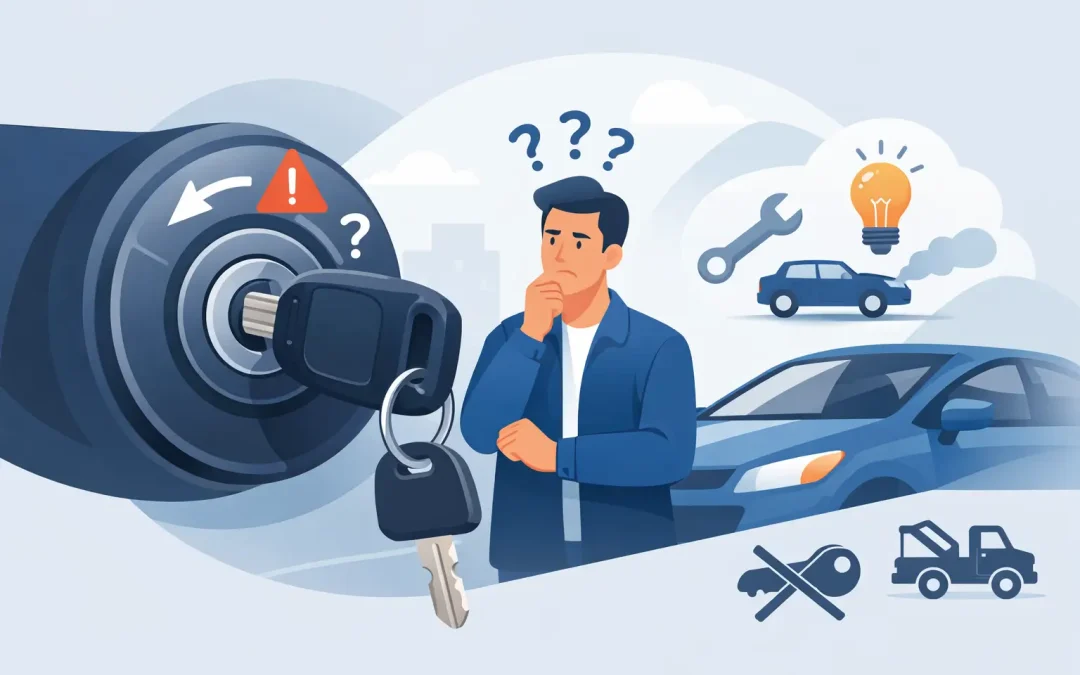
A car key not turning in lock is more than an inconvenience when you are parked outside work, collecting the kids, or trying to start a van before a job. The temptation is to force the key and get moving. That is also how a worn key becomes a snapped key, or a sticking ignition becomes a more expensive lock replacement.
Start with the simple checks, use gentle pressure only, and stop before anything bends or breaks. In many cases, the problem is a worn key, a loaded steering lock, or dirt inside the cylinder. In others, the ignition lock has failed and needs professional attention.
First, work out which lock is affected
The right next step depends on whether the key will not turn in the door lock or the ignition lock. A door lock problem may leave you unable to get into the vehicle. An ignition problem may allow you inside but prevent the vehicle from starting.
If the key turns in the door but not in the ignition, the key itself may still be worn, but the ignition cylinder is the more likely fault. If it will not turn in either lock, inspect the key carefully and try your spare key if you have one. Do not assume a remote button issue is the same as a lock issue. A flat remote battery can stop central locking, but it does not normally stop the metal emergency key from turning in a healthy mechanical lock.
Safe checks when a car key will not turn
Before calling for help, a few careful checks can save time. They should never involve force.
Release pressure from the steering wheel
A steering wheel lock can make an ignition key feel completely stuck. This often happens after the wheel has been turned once the engine is off, especially when parked with the wheels against a curb.
Hold the key in the ignition with light turning pressure toward the start position. At the same time, gently move the steering wheel left and right. One direction will usually have less resistance. When the pressure releases, the key may turn normally. Do not jerk the wheel or twist the key hard.
Check the transmission position
For an automatic vehicle, make sure the selector is firmly in Park. Try moving it into Neutral while holding the brake pedal, then try the key again. Some vehicles will not allow normal ignition operation unless the transmission position is correctly detected.
For a manual vehicle, make sure the handbrake is on and press the clutch fully. This will not repair a jammed lock, but it rules out a simple starting interlock issue.
Look closely at the key
Check for obvious bending, cracks, worn edges, or damage around the plastic head. A key that has been dropped, used to open packages, or repeatedly forced in a stiff lock can wear enough that it no longer lines up the lock pins correctly.
If you have a spare, use it once, gently. If the spare turns but the everyday key does not, stop using the worn key. Having a replacement cut from a good key or created using the correct vehicle data is far better than continuing until the key fails completely.
Consider weather and contamination
Cold, moisture, road dust, and general grime can affect exposed door locks. If the lock is frozen, use a proper lock de-icer according to its instructions. Warm the key in your hands if needed, but never use an open flame on the key or lock.
For a sticky lock, avoid spraying random household oils, grease, or thick lubricants into the cylinder. They can collect dirt and make the problem worse over time. A locksmith can clean and assess the lock properly rather than masking a developing fault.
Why the key will not turn in the ignition
Ignition locks take more wear than most drivers realize. Every start, key ring, vibration, and heavy fob puts strain on the key and cylinder. On older vehicles, worn internal wafers can stop aligning with the key. On newer vehicles, the mechanical lock may work while a separate transponder or key recognition problem prevents the engine from starting.
These are different faults. If the key physically will not rotate, the issue is usually mechanical: the key blade, the ignition barrel, or the steering lock mechanism. If the key rotates normally but the vehicle does not start, the vehicle may not be recognizing the transponder chip, the remote may be damaged, or there may be an electrical fault.
That distinction matters because replacing a remote battery will not fix a seized ignition barrel, and replacing an ignition lock without properly programming or transferring the correct security components can create additional problems.
What not to do
A key stuck in a lock can turn a small fault into a recovery job if handled roughly. Do not use pliers to twist the key. Do not hit the ignition housing, force the key with a screwdriver, or attempt to drill a lock. Those actions can damage the steering column, vehicle trim, wiring, and security components.
Avoid repeatedly wiggling the key aggressively. A little controlled movement while easing steering-wheel pressure is reasonable. Continual twisting is not. If the key snaps, removing the broken section without damaging the lock requires specialist tools.
It is also wise to remove a heavy collection of keys from the key ring. Excess weight can contribute to ignition wear over a long period, particularly on vehicles that cover high mileage or spend long days on the road.
When to call an automotive locksmith
Call a specialist if the key will not turn after the basic checks, if it is difficult to insert or remove, or if you can see any damage to the blade. You should also call for help immediately if the key has snapped, the ignition feels loose, the lock has been tampered with, or you are locked out with the keys inside.
A properly equipped mobile automotive locksmith can inspect the key and lock at your vehicle. Depending on the fault, the solution may be a new key cut and programmed on site, non-destructive entry, repair or replacement of a faulty ignition lock, or removal of a broken key fragment. The best repair depends on the vehicle, the condition of the lock, and whether the existing key can still be read and copied accurately.
For modern cars and vans, the job may also involve transponder programming. This is particularly relevant when a damaged key has an electronic chip, when all keys are lost, or when a replacement ignition component needs to work correctly with the vehicle’s security system.
Remote Key Man provides mobile car and van key support, programming, non-destructive entry, and ignition lock replacement for drivers who need the issue dealt with where the vehicle is parked. A mobile service can often avoid the cost and disruption of arranging a tow to a dealership.
Prevent the next lock failure
If your key has started sticking but still works, do not wait for it to become an emergency. Get a spare key made while there is a working original available. It is usually simpler and less costly than replacing all keys after one is lost, snapped, or trapped in a failed ignition.
Use the spare occasionally so you know it works. Keep it somewhere secure away from the vehicle, rather than inside the glove box. If your main key is cracked, bent, or has intermittent remote buttons, arrange a replacement before it leaves you stranded.
A lock that needs force is already giving you a warning. Treat it early, keep the key out of harm’s way, and let a qualified automotive locksmith inspect a persistent problem before your next journey depends on it.

Recent Comments