
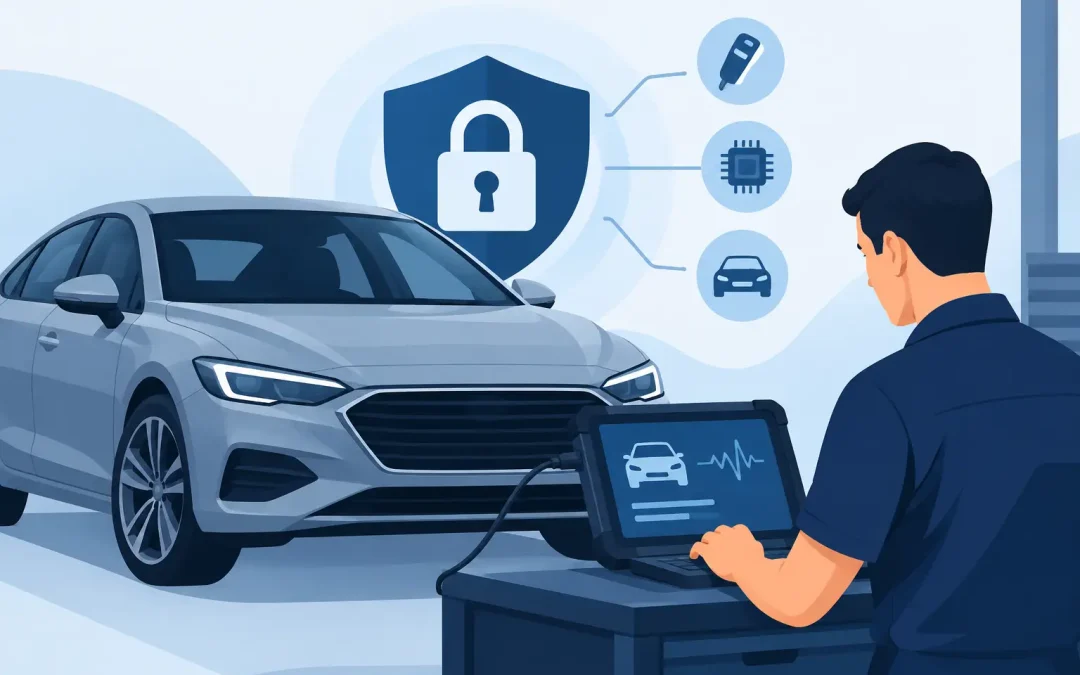
A vehicle that unlocks normally but will not start can quickly turn a routine trip into a problem. This vehicle immobiliser fault diagnosis guide explains the sensible checks to make before assuming the worst, and when a key specialist should test the system properly. An immobilizer issue is not usually something to force or work around. The right diagnosis protects your vehicle, your keys, and your time.
In the United States, this system is commonly called an immobilizer. On many British and European vehicles, you may see it written as an immobiliser. Either way, it is the electronic security system that checks for an authorized key before allowing the engine to start.
What an immobilizer fault looks like
An immobilizer fault does not always look the same. On some vehicles, the engine will crank but never fire. On others, it starts briefly and cuts out within a second or two. You may also see a key-shaped, padlock, or security warning light remain illuminated or flash on the dash.
The remote buttons can still lock and unlock the doors when the immobilizer side of the key has failed. That is because the remote central-locking function and the transponder chip used to authorize starting are often separate systems. A working remote is helpful, but it does not prove the key is being recognized by the vehicle.
A no-start condition can also come from a flat vehicle battery, starter fault, fuel issue, damaged ignition switch, or engine management problem. That is why a proper diagnosis matters. Replacing a key without checking the evidence can waste money, while repeatedly trying to start the vehicle can flatten the battery and add another issue to the job.
Start with the simple checks
Before arranging specialist help, take a calm look at the basics. Check whether the dashboard lights appear normal when the ignition is switched on. If lights are dim, flickering, or absent, the vehicle battery or its connections may be the first problem to address.
If you have a spare key, try it once. A vehicle that starts with the spare but not the everyday key strongly points to a damaged, failed, or unprogrammed transponder key. Do not continue cycling the faulty key in the ignition. One test is enough to give useful information.
For a push-button-start vehicle, make sure the key is inside the cabin and not sitting near other keys, wireless devices, or metal cases that could affect its signal. If the key fob battery warning has appeared, replace the fob battery where applicable. Keep in mind that many transponder chips work without the remote battery, so a new fob battery does not cure every no-start fault.
Look at the key itself as well. A cracked case, water damage, worn blade, loose buttons, or a key that has been dropped can all be relevant. The tiny transponder chip inside some keys can be damaged or displaced when a key shell breaks apart. Avoid taping a damaged key together and relying on it long term. It may work intermittently, then leave you stranded when you need the vehicle most.
Common causes of vehicle immobilizer faults
A failed or damaged transponder key
This is one of the most common causes. The transponder is a small chip that identifies the key to the vehicle. It may fail after impact, water exposure, poor-quality repairs, or internal wear. On older keys, a chip can sometimes be lost during a battery or case replacement.
A replacement key needs more than the correct blade shape. It must be cut accurately and programmed to the vehicle’s security system. A key that turns the ignition but has not been programmed correctly may crank the engine without allowing it to start.
A weak vehicle battery or voltage problem
Modern vehicles depend on stable voltage. A weak battery can cause warning lights, communication errors, and apparent immobilizer faults that disappear once the battery is tested, charged, or replaced. Loose terminals, corrosion, and charging faults can produce similar symptoms.
If the vehicle has been standing for days or weeks, or the engine cranks slowly, start by having the battery condition checked. It is often the quickest and least expensive possibility to rule out.
Ignition lock, reader, or antenna issues
Vehicles using an ignition barrel have a reader coil or antenna around the ignition area that detects the transponder chip. A damaged ignition lock, worn key blade, faulty reader, or wiring issue can prevent the system from seeing a valid key.
Symptoms can overlap. If the key is hard to turn, sticks in the ignition, or only works at a certain angle, the mechanical ignition lock may need attention as well as electronic testing. Forcing the key can break it or damage the lock further.
Programming or module communication faults
A key may lose synchronization after certain repairs, electrical problems, or module faults. On newer vehicles, the immobilizer function can be shared across several control modules, making generic code readers less useful than proper automotive locksmith diagnostic equipment.
This is where guesswork becomes costly. The fault could be the key, the vehicle’s antenna, a control module, or a low-voltage history stored in the system. Reading fault codes is only part of the work. The codes need to be interpreted alongside the vehicle’s symptoms and a test of the key itself.
Vehicle immobiliser fault diagnosis: what a specialist checks
A professional vehicle immobiliser fault diagnosis should establish whether the vehicle recognizes an authorized key and whether the no-start fault genuinely relates to security. A qualified mobile locksmith can test key transponders, assess remote operation, inspect the ignition area, and use specialist programming equipment to communicate with compatible vehicle systems.
The process may include checking the vehicle battery voltage, testing each available key, confirming whether the key is transmitting or responding correctly, and scanning for relevant faults. If the original key has failed, a new key can often be cut and programmed at the vehicle rather than having it recovered to a dealer.
The correct repair depends on the result. It could be a replacement remote key, a new transponder key, a repaired key shell, ignition lock replacement, or referral for an electrical or engine-management issue. A trustworthy specialist should explain which part has failed and why the recommended work is necessary.
For lost-key situations, the vehicle may need old keys removed from its memory so they can no longer start it. That is a security measure, not an inconvenience. It gives you more control if a lost key ends up in the wrong hands.
What not to do when the security light is on
Do not try online “bypass” tricks, bridge wires, or force the ignition. These can damage security modules, compromise insurance, and turn a straightforward key fault into an expensive electrical repair. The same applies to cheap unprogrammed keys bought without checking compatibility. They may fit the lock and still be unusable.
Avoid repeated jump-start attempts if the vehicle does not recognize the key. A jump-start may help a genuinely weak vehicle battery, but it will not repair a failed transponder or programming fault. If the engine starts and immediately stalls, stop trying and arrange a proper inspection.
If you only have one key and it is showing early signs of failure, do not wait for a complete breakdown. Having a tested spare made while the original still works is normally simpler and less disruptive than solving an all-keys-lost situation.
When mobile help makes sense
Mobile help is especially useful when the vehicle cannot be moved, the key has been lost or damaged, or you need a replacement programmed where you are parked. For working drivers and van owners, avoiding a tow and a long dealership wait can make a real difference.
Remote Key Man provides on-site vehicle key cutting, transponder programming, replacement remotes, non-destructive entry, and ignition lock assistance for drivers in Oldbury and the wider West Midlands. The aim is to identify the fault first, then carry out the right repair while you wait where possible.
If your vehicle is showing an immobilizer warning, keep both keys together, note exactly what the dashboard does, and avoid forcing anything. Those small details give the specialist a better starting point and help get you back behind the wheel safely.

Recent Comments